Removing ocean plastics at scale and converting them into high-value, ship-grade fuel using shipborne pyrolysis technology — while generating high-integrity carbon credits.


Without radical intervention, over 2 million additional tons of plastic enter our oceans annually. Current solutions cannot keep pace — Pacific Reset is built to change that equation.
The scale of marine plastic pollution demands a radical, scalable approach beyond traditional methods.
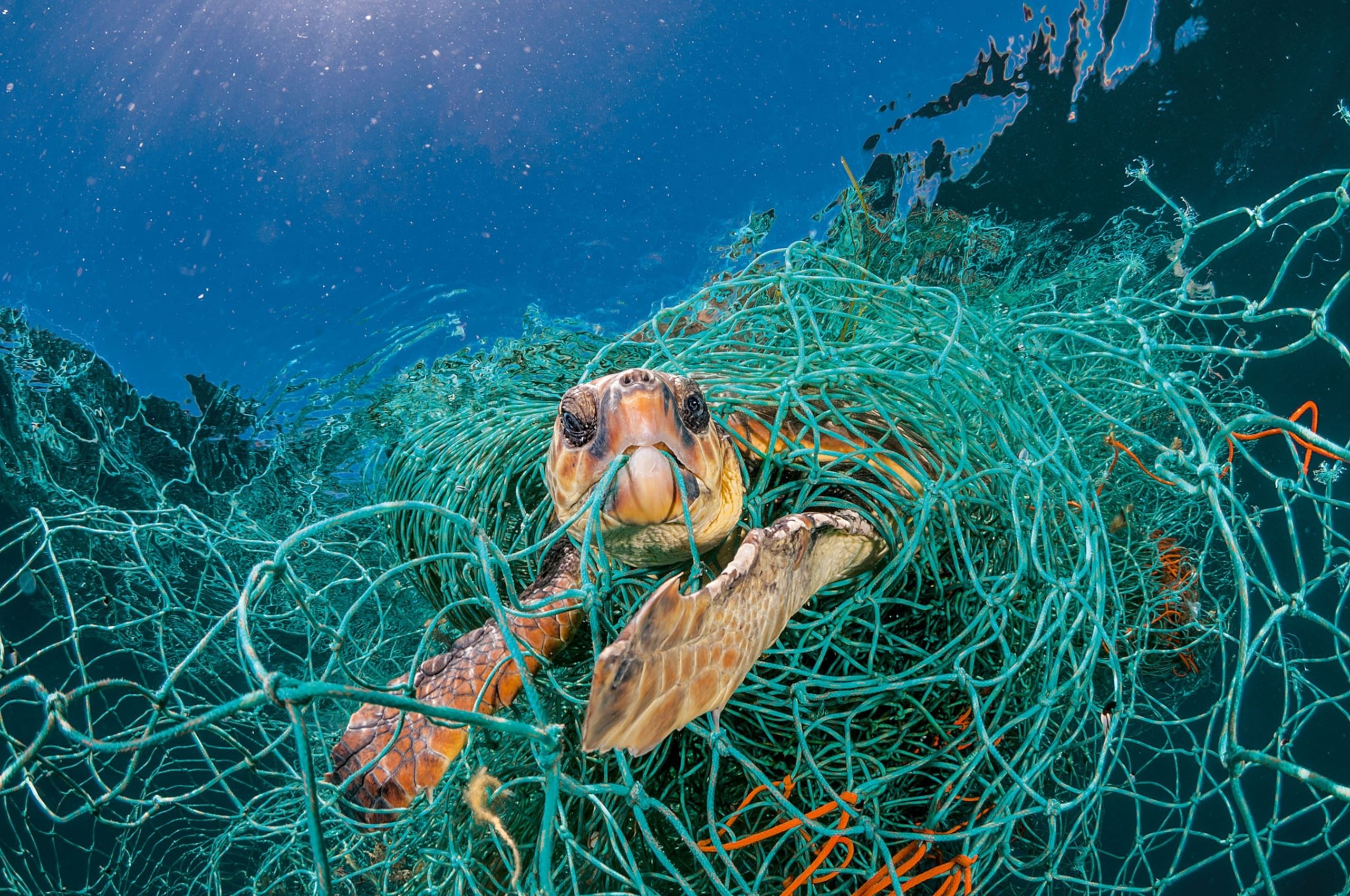
Marine plastic pollution represents one of the most pressing environmental crises of our time. Plastics fragment into microplastics entering the food chain, threatening marine biodiversity, fisheries, and ultimately human health.
Traditional coastal cleanup approaches are insufficient. The vast majority of plastic accumulates in offshore gyres, far beyond the reach of conventional collection vessels.
Pacific Reset uniquely converts the liability of ocean plastic into a high-value commodity — ship-grade fuel — while simultaneously sequestering carbon and generating verified carbon credits.
Trapped by the North Pacific Gyre — a massive rotating ocean current — billions of pieces of plastic debris have accumulated into what scientists call the Great Pacific Garbage Patch, or "Pacific Trash Vortex."
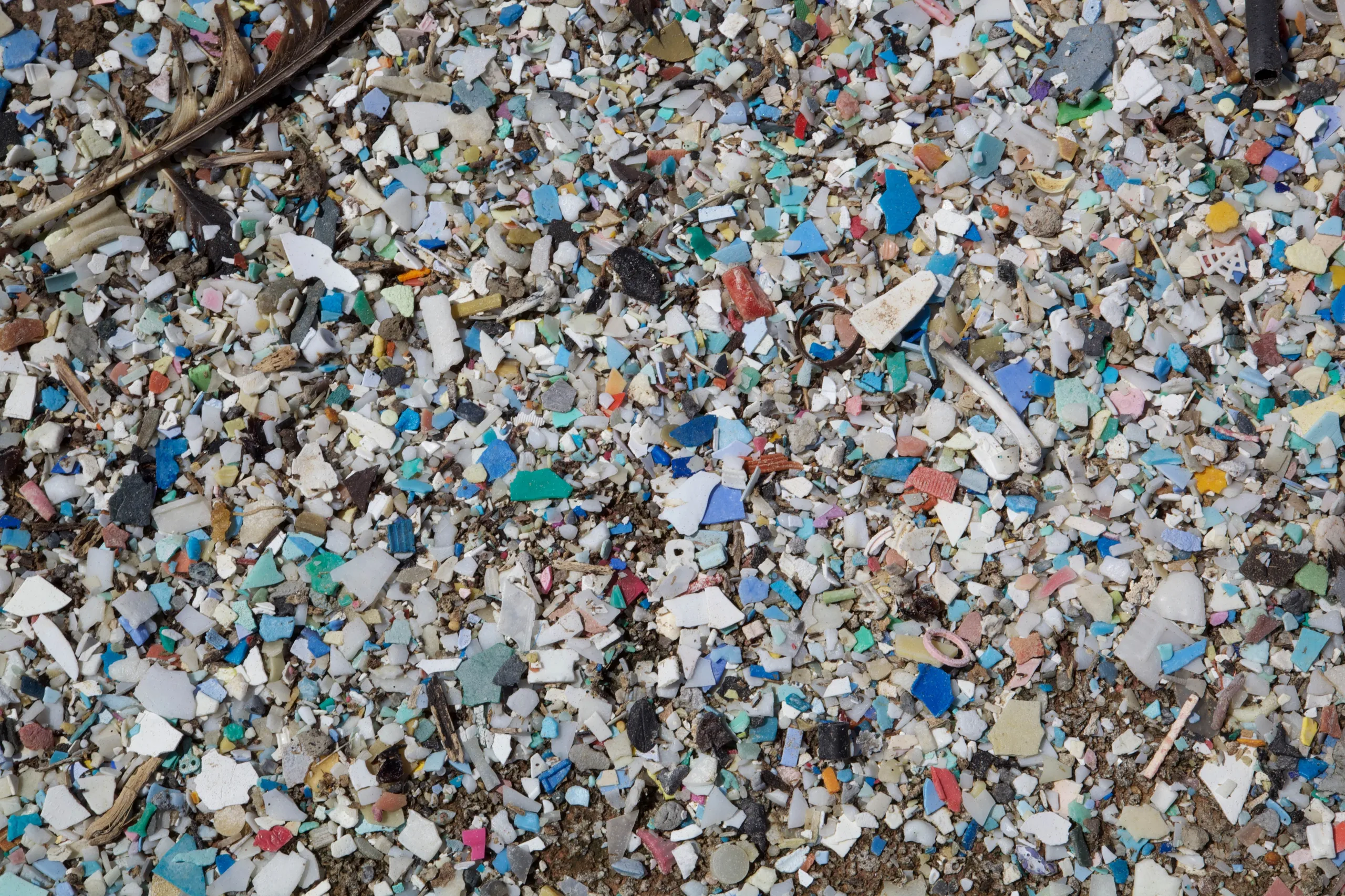
The Great Pacific Garbage Patch (GPGP) is located in the North Pacific Ocean, roughly halfway between Hawaii and California. It is not a solid island of trash — it is a vast, swirling soup of plastic fragments, fishing nets, and marine debris, much of it invisible as microplastics.
The patch spans an estimated 1.6 million square kilometres — twice the size of Texas — and contains over 80,000 metric tonnes of plastic. It is held in place by the rotating North Pacific Subtropical Gyre, a circular ocean current system that acts as a giant centrifugal trap.
Unlike land-based garbage, the GPGP is almost impossible to see from above. Up to 70% of debris sinks below the surface, and the remaining 30% degrades under UV radiation into microplastics smaller than a grain of rice — entering the marine food chain at every level, from zooplankton to tuna to humans.
The North Pacific Subtropical Gyre is a slow-moving anticyclonic circulation system. Debris caught in its currents spirals inward and concentrates in the central "accumulation zone" — often remaining trapped for decades or longer.
As plastics break down into microplastics and nanoplastics, they are ingested by zooplankton, fish, seabirds, and marine mammals — bioaccumulating up the food chain to human dinner tables worldwide.
The GPGP has been growing since the 1950s. Plastic from the 1960s and 70s is still present today. Without intervention, the patch will continue growing exponentially as global plastic production accelerates.
The GPGP is just one of five major ocean gyres globally accumulating plastic. The North Atlantic, South Pacific, South Atlantic, and Indian Ocean gyres each host similar and rapidly growing garbage patches.
Approximately 80% of ocean plastic originates from land-based sources — rivers, coastal cities, and runoff. The remaining 20% comes from marine industries: fishing gear, shipping, and offshore platforms.
Covering the GPGP's 1.6M km² with conventional vessels would take thousands of years. Offshore gyres are unreachable by coastal programs. A radical, at-sea, industrial-scale solution is the only credible answer.
Mass production of single-use plastics begins. Early plastic waste enters ocean currents for the first time. Scientists observe unusual floating debris concentrations forming in the North Pacific.
NOAA researchers publish the first scientific paper predicting the accumulation of plastic debris in the North Pacific — describing the physics of gyre-driven concentration zones.
Oceanographer Charles Moore discovers the eastern patch while sailing from Hawaii to California — describing sailing through a "plastic soup" for days, hundreds of miles from any coastline.
Scientific expeditions quantify the patch at between 700,000 km² and 15 million km². The term "Great Pacific Garbage Patch" enters mainstream global media and public consciousness.
First comprehensive aerial and surface survey estimates the GPGP at 1.6 million km² containing 80,000+ metric tonnes — 16 times larger than previously estimated. Published in Scientific Reports.
Pacific Reset deploys the world's first fleet of shipborne pyrolysis reactor vessels to tackle the GPGP at source — collecting, converting, and commercialising ocean plastic at unprecedented scale.
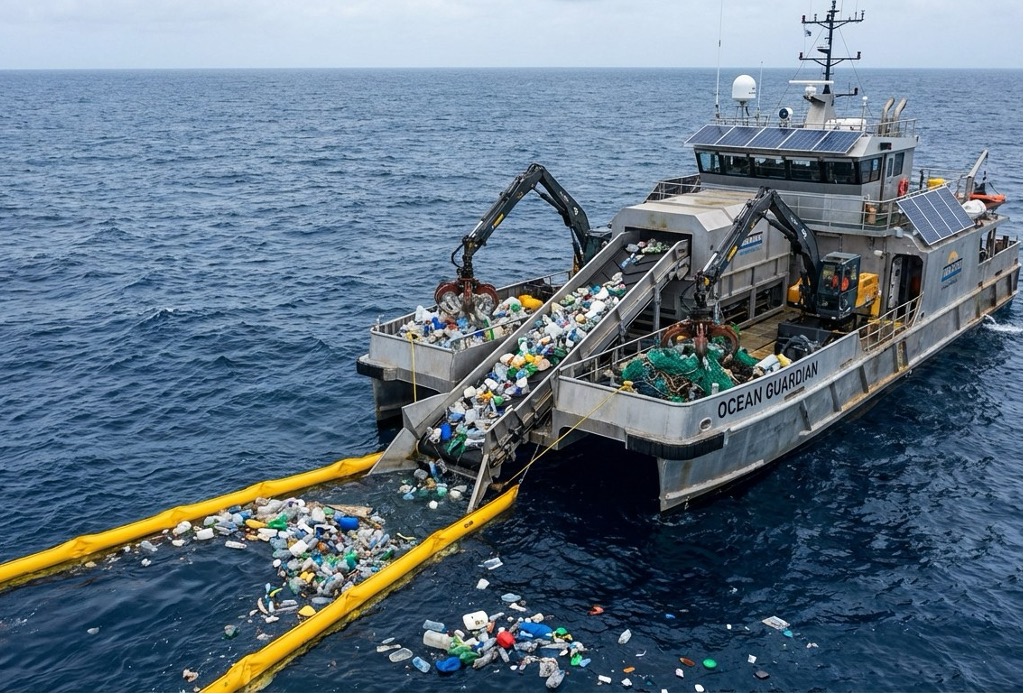
Pacific Reset deploys a fleet of purpose-built reactor ships equipped with robotics and on-board pyrolysis systems to collect and process ocean plastic at the source.
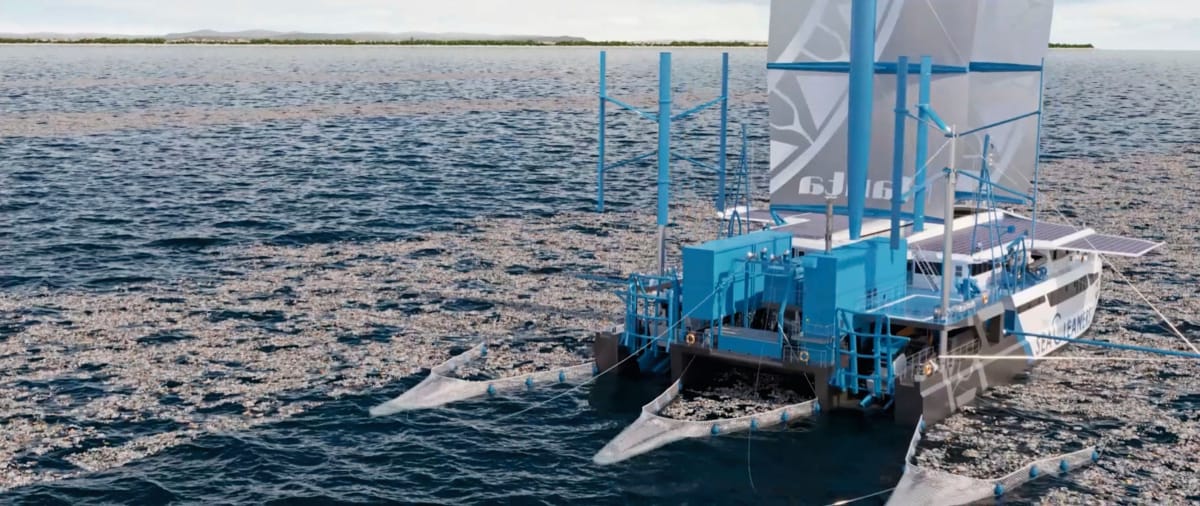
Purpose-built ocean cleanup vessels deploying collection systems in open ocean — the operational model Pacific Reset is scaling with on-board pyrolysis technology.
Autonomous surface vessels equipped with AI-guided robotic arms and collection nets deploy from the mothership to capture plastics across wide ocean zones, including the deep gyres.
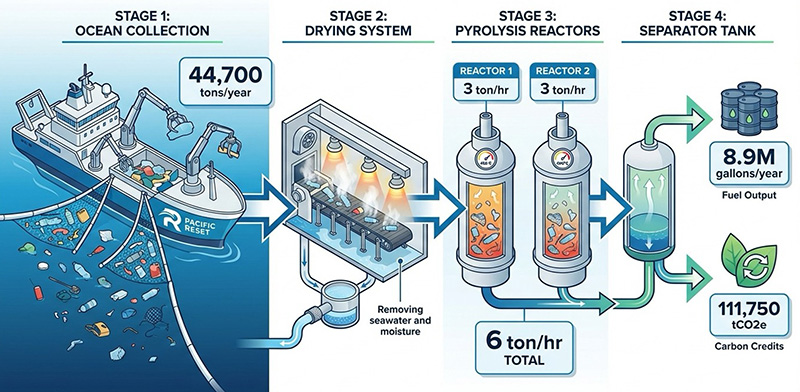
Collected plastics are processed on-board via thermal pyrolysis — converting polymers into synthetic crude oil and refined ship-grade fuel oil without combustion or emissions to sea.
Processed fuel is stored on-board and transferred at-sea to commercial shipping partners, reducing the operational cost of collection voyages and generating direct revenue.
Each tonne of plastic removed and converted is fully tracked and audited, generating high-integrity carbon credits certified to leading international standards (Verra, Gold Standard).
Our solution creates fuel from waste, removing plastic from the ocean using pyrolysis technology and logistics.
Our marine-optimised pyrolysis reactors are engineered for shipborne operation — compact, modular, and capable of processing mixed plastic waste streams.
Surface drones use computer vision to identify and collect plastic concentrations with minimal bycatch. Operating range of 15 nautical miles from the mothership.
Each reactor module processes 10–15 tonnes of plastic per day, converting it into ~8,000 litres of synthetic fuel. Multiple modules can be stacked per vessel.
Pyrolysis gases are captured and used to power the reactor itself — a self-sustaining energy loop. All non-condensable residues are safely processed on-board.
Every kilogram of plastic collected is logged on an immutable ledger with GPS coordinates, supporting the most rigorous Monitoring, Reporting and Verification requirements.
Pacific Reset is unique in generating both direct fuel revenues and carbon credit revenues from a single operation — ensuring financial resilience across market cycles.
Our operations generate returns from three independent but synergistic revenue sources, providing resilience and upside across market conditions.
Per tonne of ship-grade fuel produced. Direct offtake agreements with commercial shipping operators provide predictable revenue from day one of operations.
Per tonne of plastic removed. Premium certified credits targeting corporate net-zero buyers and ESG fund mandates. Credits carry ocean plastic removal additionality premium.
Per tonne collected. Paid collection contracts from environmental agencies, governments, and NGOs committed to meeting international marine pollution targets and Blue Economy goals.
Co-branded ocean cleanup programs for corporates with plastic-intensive supply chains (FMCG, beverages, consumer goods) seeking Extended Producer Responsibility compliance.
Pacific Reset's removal credits command a significant premium in voluntary carbon markets due to the rarity, traceability, and additionality of ocean plastic removal.
Each credit represents a tonne of plastic that would not otherwise have been removed. Pyrolysis permanently destroys the plastic polymer — there is no reversal risk.
From GPS-tagged collection through processing to fuel or char output — every kilogram is tracked and independently audited to meet Article 6 and CORSIA standards.
Fortune 500 companies with ocean plastic commitments (Unilever, Nestlé, P&G and more) are actively seeking high-quality marine removal credits to meet 2030 targets.
Shipping industry carbon regulations (IMO 2050 targets) create captive demand for credits that can be used for maritime decarbonisation — our primary offtake market.
A capital-efficient fleet scaling model with strong unit economics and multiple exit pathways for investors.
Pacific Reset operates at the intersection of environmental impact and commercial return — a uniquely compelling proposition for the world's leading ESG investors.
Sovereign wealth funds, pension funds, and dedicated impact vehicles seeking verifiable ocean & climate impact alongside competitive risk-adjusted returns.
Commercial shipping operators seeking IMO-compliant low-carbon fuel alternatives and carbon credits to offset fleet emissions under MARPOL regulations.
Ocean conservation foundations (5 Gyres, Ocean Conservancy, WWF) and philanthropic vehicles funding the removal of legacy marine plastic at scale.
FMCG, beverage, and consumer goods brands with plastic commitments seeking Extended Producer Responsibility credits and co-branded cleanup programs.
No scalable, commercial ocean plastic removal solution exists today. Pacific Reset is the only venture combining shipborne pyrolysis, AI-guided collection, and carbon credit monetisation — at sea, at scale.
Pacific Reset is raising its seed and Phase 1 round to commission the first reactor vessel and generate proof-of-concept data for fleet expansion.
Projected Base Case Internal Rate of Return over 10-year horizon
Revenue target by Year 7 across full fleet operations
This is a strictly private & confidential document. To request a full information memorandum, arrange a call with our team, or discuss investment terms, please contact us directly.